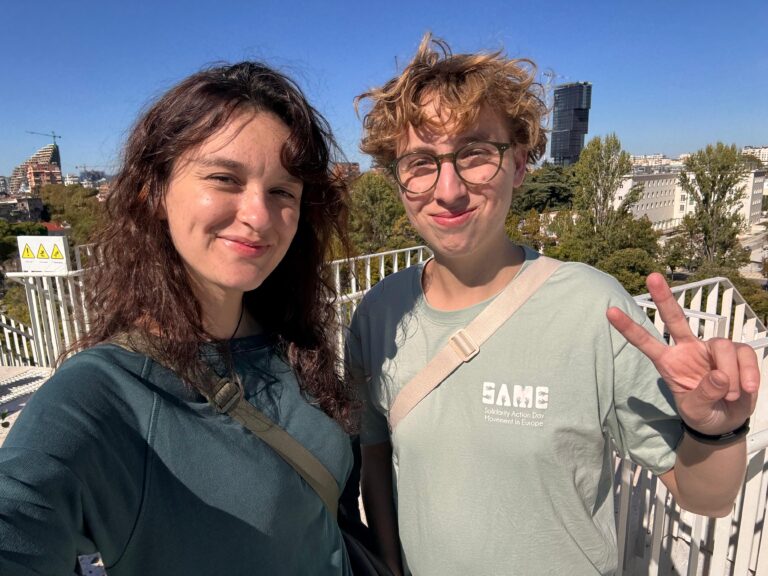
In October 2025, SAME volunteers carried out a series of visits to member organisations across Europe as part of the “SAME on the Move” journey, with stops in Italy, Albania, North Macedonia, Kosovo, Montenegro, and Bosnia and Herzegovina. The visits created an important opportunity for exchange with organisations actively implementing Solidarity Action Day in their national contexts, while also helping a new generation of SAME volunteers gain a closer understanding of the network, its diversity, and its impact on the ground.
The main aim of the journey was to explore how Solidarity Action Day is implemented in different countries, discuss challenges and future plans, and reflect on how SAME can better support member organisations in strengthening and expanding the initiative. At the same time, the visits reinforced cooperation across the network by creating space for direct dialogue, mutual learning, and shared reflection on the development of youth-led solidarity work in different contexts.
Across all visits, SAME met with member organisations to discuss their implementation models, achievements, current needs, and future ambitions. A recurring topic throughout the journey was the role that more experienced organisations can play in supporting and mentoring newer members of the network, helping strengthen quality, continuity, and shared ownership across SAME.
In Italy, SAME met with Operation Daywork Italy and Social Day Italy in Bolzano and Bassano del Grappa to discuss the current implementation of Social Day, the challenges both organisations are facing, and possibilities for expanding the initiative to more regions in the country. In Tirana, AS@N presented the strong growth of Solidarity Action Day in Albania, which has developed from a new initiative into a nationwide effort involving multiple regions, around 90 businesses, and more than 300 young people. In Skopje, Youth Can shared its long-standing work with young people and showed how Solidarity Action Day has been used to support youth participation, activism, and mental health, including through the opening of mental health hubs in high schools.
In Pristina, TOKA presented the rapid development of Solidarity Action Day in Kosovo, including its expansion through cooperation with municipalities and schools, as well as examples of international implementation in London and Brussels. In Podgorica, Srednjoškolci Crne Gore reflected on the long-term development of Solidarity Action Day in Montenegro and how funds raised through the initiative directly support youth projects and participating schools. In Sarajevo, ASuBiH, together with its partner ONAuBiH, shared the long-term impact of Solidarity Action Day in Bosnia and Herzegovina, including large-scale youth participation, cooperation with thousands of businesses, and substantial support raised for youth-related projects.
The main outputs of the journey were direct exchanges with member organisations, a clearer overview of implementation realities across different countries, and stronger connections between SAME volunteers and the organisations that form the network. The main outcomes were a deeper understanding of the diversity and impact of Solidarity Action Day across Europe, stronger relationships within the network, and clearer identification of shared priorities for future support, collaboration, and mentoring between organisations.